```
_______ __ _____ ___ __ ___________ _______
/" "||" \ (\" \|" \ |" \(" _ ")/" __ )
(: ______)|| | |.\\ \ | || |)__/ \\__/(__/ _) ./
\/ | |: | |: \. \\ | |: | \\_ / / //
// ___) |. | |. \ \. | |. | |. | __ \_ \\
(: ( /\ |\| \ \ | /\ |\ \: | (: \__) :\
\__/ (__\_|_)\___|\____\)(__\_|_) \__| \_______) ... Yes, we need a new logo!
```
Fast init for Linux
===================
[![Travis Status]][Travis] [![Coverity Status]][Coverity Scan]
Table of Contents
-----------------
* [Introduction](#introduction)
* [Features](#features)
* [/etc/finit.conf](doc/config.md#etcfinitconf)
* [/etc/finit.d](doc/config.md#etcfinitd)
* [Runparts & /etc/rc.local](#runparts--etcrclocal)
* [Bootstrap](doc/bootstrap.md#bootstrap)
* [Runlevels](#runlevels)
* [Inetd](doc/inetd.md#inetd)
* [Hooks, Callbacks & Plugins](doc/plugins.md#hooks-callbacks--plugins)
* [Rebooting & Halting](#rebooting--halting)
* [Commands & Status](#commands--status)
* [Building](doc/build.md#building)
* [Running](#running)
* [Debugging](#debugging)
* [Origin & References](#origin--references)
Introduction
------------
Finit is a plugin-based init with [process supervision][1] similar to
that of D.J. Bernstein's [daemontools][2] and Gerrit Pape's [runit][3].
The main focus of Finit is on small and embedded Linux systems, yet
fully usable on server and desktop installations as well. See the
[contrib section](contrib/) for Debian and Alpine examples.
Traditional [SysV init][4] style systems are scripted. For low-resource
embedded systems this is quite resource intensive and often leads to
long boot times. Finit reduces context switches and forking of shell
scripts to provide a swift [system bootstrap](doc/bootstrap.md) written
entirely in C.
Configuration is read from [/etc/finit.conf](doc/config.md#etcfinitconf)
which details kernel modules to load, services and TTYs to start. When
initial [bootstrap](doc/bootstrap.md) is done, including setting up
networking, [/etc/finit.d/](doc/config.md#etcfinitd) and the familiar
[/etc/rc.local](#runparts--etcrclocal) are run.
**Example /etc/finit.conf:**
```
# Fallback if /etc/hostname is missing
host wopr
# Runlevel to start after bootstrap, runlevel 'S'
runlevel 2
# Services to be monitored and respawned as needed
service [S12345] /sbin/watchdogd -L -f -- System watchdog daemon
service [S12345] /sbin/syslogd -n -b 3 -D -- System log daemon
service [S12345] /sbin/klogd -n -- Kernel log daemon
service 2345] /sbin/lldpd -d -c -M1 -H0 -i -- LLDP daemon (IEEE 802.1ab)
# For multiple instances of the same service, add :ID somewhere between
# the service/run/task keyword and the command.
service :1 [2345] /sbin/merecat -n -p 80 /var/www -- Web server
service :2 [2345] /sbin/merecat -n -p 8080 /var/www -- Old web server
# Alternative method instead of below runparts, can also use /etc/rc.local
#task [S] /etc/init.d/keyboard-setup start -- Setting up preliminary keymap
#task [S] /etc/init.d/acpid start -- Starting ACPI Daemon
#task [S] /etc/init.d/kbd start -- Preparing console
# Inetd services to start on demand, with alternate ports and filtering
inetd ftp/tcp nowait [2345] /sbin/uftpd -i -f -- FTP daemon
inetd tftp/udp wait [2345] /sbin/uftpd -i -y -- TFTP daemon
inetd time/udp wait [2345] internal -- UNIX rdate service
inetd time/tcp nowait [2345] internal -- UNIX rdate service
inetd 3737/tcp nowait [2345] internal.time -- UNIX rdate service
inetd telnet/tcp nowait [2345] /sbin/telnetd -i -F -- Telnet daemon
inetd 2323/tcp nowait [2345] /sbin/telnetd -i -F -- Telnet daemon
inetd 222/tcp@eth0 nowait [2345] /sbin/dropbear -i -R -F -- SSH service
inetd ssh/tcp@*,!eth0 nowait [2345] /sbin/dropbear -i -R -F -- SSH service
# Run start scripts from this directory
# runparts /etc/start.d
# Virtual consoles to start built-in getty on
tty [12345] /dev/tty1 115200 linux
tty [12345] /dev/ttyAMA0 115200 vt100
```
For an example of a full blown embedded Linux, see [TroglOS][9], or take
a look at the `contrib/` section with [Alpine Linux](contrib/alpine/),
[Debian](contrib/debian/), support and more.
Features
--------
**Process Supervision**
Start, monitor and restart services should they fail.
**Inetd**
Finit comes with a built-in [inetd server](doc/inetd.md). No need to
maintain a separate config file for services that you want to start on
demand.
All inetd services started can be filtered per port and inbound
interface, reducing the need for a full blown firewall.
Built-in optional inetd services:
- echo RFC862
- chargen RFC864
- daytime RFC867
- discard RFC863
- time (rdate) RFC868
For more information, see [doc/inetd.md](doc/inetd.md).
**Getty**
Finit also comes with a built-in Getty for Linux console TTYs. It can
parse `/etc/inittab` and set the speed. Then `/bin/login` handles all
nasty bits with PAM etc.
# /etc/finit.conf
tty [12345] /dev/tty1 38400 linux
tty [12345] /dev/ttyAMA0 115200 vt100
**Runlevels**
Runlevels are optional in Finit, but support for [SysV runlevels][5] is
available if needed. All services in runlevel S(1) are started first,
followed by the desired run-time runlevel. Runlevel S can be started in
sequence by using `run [S] cmd`. Changing runlevels at runtime is done
like any other init, e.g. init 4
**Plugins**
Finit plugins can be *callbacks*, *boot hooks* into different stages of
the boot process, or *pure extensions*. Plugins are written in C and
compiled into a dynamic library that is loaded automatically by finit at
boot. A basic set of plugins that extend and modify the basic behavior
are bundled in the `plugins/` directory.
Capabilities:
- **Task/Run/Service callbacks**
Modify service arguments, override service monitor's decisions to
start/stop/reload a service.
- **Hooks**
Hook into the boot at predefined points to extend Finit
- **I/O**
Listen to external events and control Finit behavior/services
- **Inetd**
Extend Finit with internal inetd services, for an example, see
`plugins/time.c`
Extensions and functionality not purely related to what an `/sbin/init`
needs to start a system are available as a set of plugins that either
hook into the boot process or respond to various I/O.
For more information, see [doc/plugins.md](doc/plugins.md).
Runparts & /etc/rc.local
------------------------
At the end of the boot, when networking and all services are up, finit
calls its built-in [run-parts(8)][] on the `runparts ` directory,
and `/etc/rc.local`, in that order if they exist.
```shell
runparts /etc/rc.d/
```
No configuration stanza in `/etc/finit.conf` is required for `rc.local`.
If it exists and is an executable shell script, finit calls it at the
very end of the boot, before calling the `HOOK_SYSTEM_UP`. See more on
hooks in [doc/plugins.md](doc/plugins.md#hooks), and about the system
bootstrap in [doc/bootstrap.md](doc/bootstrap.md).
Runlevels
---------
Basic support for [runlevels][5] is included in Finit from v1.8. By
default all services, tasks, run commands and TTYs listed without a set
of runlevels get a default set `[234]` assigned. The default runlevel
after boot is 2.
Finit supports runlevels 0-9, and S, with 0 reserved for halt, 6 reboot
and S for services to only run at bootstrap. Runlevel 1 is the single
user level, where usually no networking is enabled. In Finit this is
more of a policy for the user to define. Normally only runlevels 1-6
are used, and even more commonly, only the default runlevel is used.
To specify an allowed set of runlevels for a `service`, `run` command,
`task`, or `tty`, add `[NNN]` to your `/etc/finit.conf`, like this:
```shell
service [S12345] /sbin/syslogd -n -x -- System log daemon
run [S] /etc/init.d/acpid start -- Starting ACPI Daemon
task [S] /etc/init.d/kbd start -- Preparing console
service [S12345] /sbin/klogd -n -x -- Kernel log daemon
tty [12345] /dev/tty1
tty [2] /dev/tty2
tty [2] /dev/tty3
tty [2] /dev/tty4
tty [2] /dev/tty5
tty [2] /dev/tty6
```
In this example syslogd is first started, in parallel, and then acpid is
called using a conventional SysV init script. It is called with the run
command, meaning the following task command to start the kbd script is
not called until the acpid init script has fully completed. Then the
keyboard setup script is called in parallel with klogd as a monitored
service.
Again, tasks and services are started in parallel, while run commands
are called in the order listed and subsequent commands are not started
until a run command has completed.
Switching between runlevels can be done by calling init with a single
argument, e.g. init 5 switches to runlevel 5. When changing
runlevels Finit also automatically reloads all `.conf` files in the
`/etc/finit.d/` directory. So if you want to set a new system config,
switch to runlevel 1, change all config files in the system, and touch
all `.conf` files in `/etc/finit.d` before switching back to the
previous runlevel again — that way Finit can both stop old services and
start any new ones for you, without rebooting the system.
Rebooting & Halting
-------------------
Finit is often used on embedded and small Linux systems with BusyBox.
For compatibility with its existing toolset (halt, poweroff, reboot),
the following signals have been adopted:
* `SIGUSR1`
Same effect as `finit q`, reloads all *.conf files in `/etc/finit.d/`
* `SIGUSR1`
Calls shutdown hooks, including HOOK_SHUTDOWN, stops all running
processes, and unmounts all file systems. Then tells kernel to
halt. Most people these days want SIGUSR2 though.
SysV init and systemd use this to re-open their FIFO/D-Bus.
* `SIGUSR2`
Like SIGUSR1, but tell kernel to power-off the system, if ACPI
or similar exists to actually do this. If the kernel fails
power-off, Finit falls back to halt.
SysV init N/A, systemd dumps its internal state to log.
* `SIGTERM`
Like `SIGUSR1`, but tell kernel to reboot the system when done.
SysV init N/A, systemd rexecutes itself.
* `SIGINT`
Sent from kernel when the CTRL-ALT-DEL key combo is pressed.
SysV init and systemd default to reboot with `shutdown -r`.
Finit currently forwards this to `SIGTERM`.
* `SIGPWR`
Sent from a power daemon, like `powstatd(8)`, on changes to the
UPS status. Traditionally SysV init read /etc/powerstatus and
acted on "OK", "FAIL", or "LOW" and then removed the file.
Finit currently forwards this to `SIGUSR2`.
Finit also listens to the classic SysV init FIFO, which used to be
located in `/dev` but these days default to `/run/initctl`. So existing
tools like, `poweroff`, `halt`, `reboot`, and `shutdown` work as
expected. Support for this old-style handling is implemented in the
optional `initctl.so` plugin and can be accessed with the traditional
`telinit` command line tool, symlinked to `finit`. Hence, if finit is
your system init, then `init q` will work as the UNIX beards intended.
```shell
~ $ telinit
Usage: telinit [OPTIONS] [q | Q | 0-9]
Options:
-h, --help This help text
-v, --version Show Finit version
Commands:
q | Q Reload *.conf in /etc/finit.d/, like SIGHUP
0 - 9 Change runlevel: 0 halt, 6 reboot
```
Commands & Status
-----------------
Finit also implements a more modern API to query status, and start/stop
services, called `initctl`. Unlike `telinit` the `initctl` tool does
not return until the given command has fully completed.
```shell
~ $ initctl -h
Usage: initctl [OPTIONS]
Options:
-d, --debug Debug initctl (client)
-v, --verbose Verbose output
-h, --help This help text
Commands:
debug Toggle Finit (daemon) debug
help This help text
reload Reload *.conf in /etc/finit.d/ and activate changes
runlevel [0-9] Show or set runlevel: 0 halt, 6 reboot
status | show Show status of services
cond set Set (assert) condition => +COND
cond clear Clear (deassert) condition => -COND
cond flux Emulate flux condition => ~COND
cond show Show condition status
start [:ID] Start service by job# or name, with optional ID
stop [:ID] Stop/Pause a running service by job# or name
restart [:ID] Restart (stop/start) service by job# or name
reload [:ID] Reload (SIGHUP) service by job# or name
version Show Finit version
```
The `` notation to a service stanza can be used empty, then it will
apply to `reload` and `runlevel` commands. I.e., when a service's
`.conf` file has been changed Finit will stop and start it instead. If
a service does *not* have `` declared, the service will be reloaded
(`SIGHUP`:ed) in the `START` phase instead. The latter is the preferred
behaviour, but not all daemons support this, unfortunately.
**Note:** even though it is possible to start services not belonging to
the current runlevel these services will not be respawned automatically
by Finit if they exit (crash). Hence, if the runlevel is 2, the below
Dropbear SSH service will not be restarted if it is killed or exits.
```shell
~ $ initctl status -v
1 running 476 [S12345] /sbin/watchdog -T 16 -t 2 -F /dev/watchdog
2 running 477 [S12345] /sbin/syslogd -n -b 3 -D
3 running 478 [S12345] /sbin/klogd -n
4:1 inetd 0 [2345] internal time allow *:37
4:2 inetd 0 [2345] internal time allow *:37
4:3 inetd 0 [2345] internal 3737 allow *:3737
5:1 inetd 0 [2345] /sbin/telnetd allow *:23 deny eth0,eth1
5:2 inetd 0 [2345] /sbin/telnetd allow eth0:2323,eth2:2323,eth1:2323
6:1 inetd 0 [345] /sbin/dropbear allow eth0:222
6:2 inetd 0 [345] /sbin/dropbear allow *:22 deny eth0
```
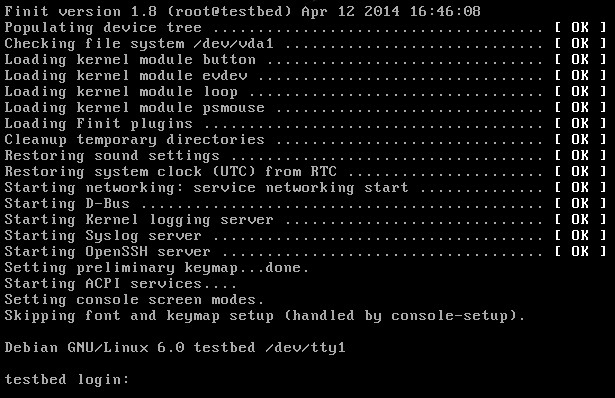
Running
-------
Having successfully [built Finit](doc/build.md) it may now be time to
take it for a test drive. The `make install` attempts to set up finit
as the system system init, `/sbin/init`, but this is usually a symlink
pointing to the current init.
So either change the symlink, or change your boot loader (GRUB, LOADLIN,
LILO, U-Boot/Barebox or RedBoot) configuration to append the following
to the kernel command line:
```shell
init=/sbin/finit
```
Remember to also set up an initial `/etc/finit.conf` before rebooting!
Debugging
---------
Add `finit_debug`, or `--debug`, to the kernel command line to enable
debug messages. See the output from `configure --help` for more on
how to assist debugging.
```shell
init=/sbin/finit --debug
```
Origin & References
-------------------
This project is based on the [original finit][] by [Claudio Matsuoka][]
which was reverse engineered from syscalls of the [EeePC fastinit][] —
"gaps filled with frog DNA …"
Finit is developed and maintained by [Joachim Nilsson][] at [GitHub][].
Please file bug reports, clone it, or send pull requests for bug fixes
and proposed extensions.
[1]: https://en.wikipedia.org/wiki/Process_supervision
[2]: http://cr.yp.to/daemontools.html
[3]: http://smarden.org/runit/
[4]: http://en.wikipedia.org/wiki/Init
[5]: http://en.wikipedia.org/wiki/Runlevel
[9]: https://github.com/troglobit/troglos
[run-parts(8)]: http://manpages.debian.org/cgi-bin/man.cgi?query=run-parts
[original finit]: http://helllabs.org/finit/
[EeePC fastinit]: http://wiki.eeeuser.com/boot_process:the_boot_process
[Claudio Matsuoka]: https://github.com/cmatsuoka
[Joachim Nilsson]: http://troglobit.com
[GitHub]: https://github.com/troglobit/finit
[Travis]: https://travis-ci.org/troglobit/finit
[Travis Status]: https://travis-ci.org/troglobit/finit.png?branch=master
[Coverity Scan]: https://scan.coverity.com/projects/3545
[Coverity Status]: https://scan.coverity.com/projects/3545/badge.svg